The One-Shot Method in 2D
Inside-Outside Tests
Determining whether a point lies inside or outside of a shape is a classical problem in computer graphics. Consider the polygon below and two query points A and B. Intuitively, point A is inside the polygon and point B is outside.
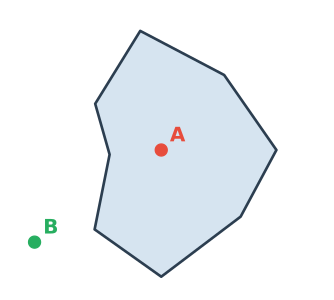
How could we determine this inside-outside classification algorithmically, using the query point and the polygon’s line segments?
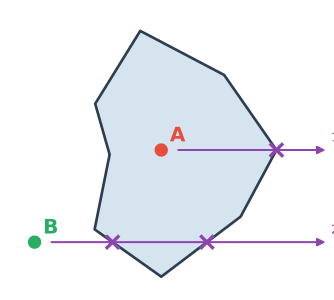
A solution: shoot a ray originating at the query point, in any direction, and count the number of intersections. If there is an odd number of intersections, the query point lies inside the shape. Accordingly, if there is an even number of intersections, the query point lies outside the shape. This algorithm works because the polygon separates the plane into two distinct regions: inside and outside. As the ray crosses the polygon, it moves from one region to the other, alternating between entering and exiting the shape. This raycasting technique is known as the even-odd rule. The method has a few edge cases to consider, but to keep this post brief, we will not discuss them.
Open Geometry
Geometry in computer graphics is not guaranteed to be closed. In practice, we encounter open shapes that do not partition the space into inside and outside regions, this is especially true for 3D meshesNearly 15% of the 3D printing models in the Thingi10K dataset (Zhou, 2016) are open surfaces. . The even-odd rule algorithm breaks down on open shapes, the gaps remove intersections, leading to an incorrect containment result.
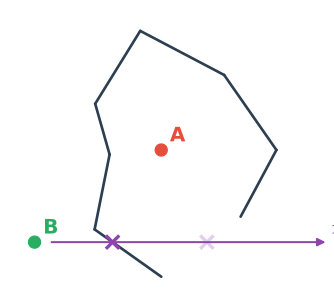
A good question here is: What even is “inside” for an open shape?
Generalized Winding Numbers enable us to compute whether a point lies inside or outside of an open shape, but before introducing them, we should discuss (regular) winding numbers, since they are a natural extension.
Winding Numbers
Unlike the previous section that uses unoriented polygons, winding numbers require orientation. In addition, it is more advantageous here to see the shapes as oriented 2D curves.
The winding number of a query point with respect to an oriented curve is the number of times that this curve winds around the point. This is a signed quantity, where the orientation of the curve matters. The location of the point matters. Let’s look at a few examples:
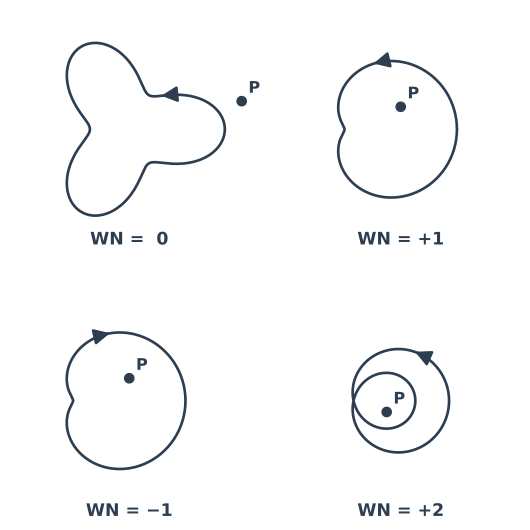
Winding numbers can be used to answer inside-outside queries. A point with a winding number of one is inside, and a point with a winding number of zero is outside. For values other than one and zero, we can use the non-zero rule: consider all values as inside with the exception of zero being outside.
To compute winding numbers, we can also use a raycasting technique. Instead of computing the parity of the intersections, instead we look at the number of signed intersections. These intersections are signed: they add +1 when the ray intersects the curve in a counter-clockwise manner, and -1 clockwise. To clarify, for a ray shot towards the right, an intersection with the oriented curve going upwards is counter-clockwise (+1), if the curve goes downwards it is clockwise (-1).
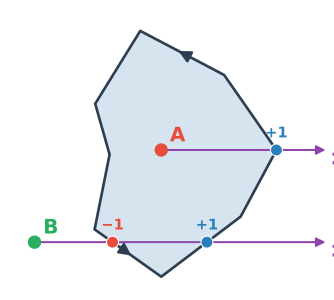
Similar to the earlier parity test, the direction of the ray is arbitrary. Given a query point, the sum of signed intersections does not depend on the chosen ray direction.
Generalized Winding Numbers
Generalized winding numbers (GWN) are a relaxation of winding numbers to open curves. For closed curves, the chosen ray direction does not affect the result, however, this is not true on open curves.
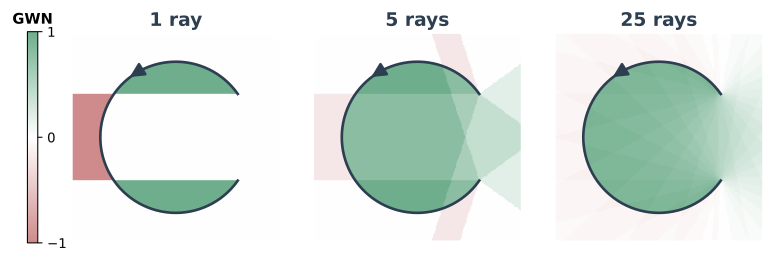
Rather than considering a point as strictly inside or strictly outside, we can recover a continuous notion of insideness: Generalized Winding Numbers. They are expensive to compute via naive raycasting, but possible. Generalized Winding Numbers can be approximated by shooting a multitude of rays, creating a smooth field that is only discontinuous across the curve.
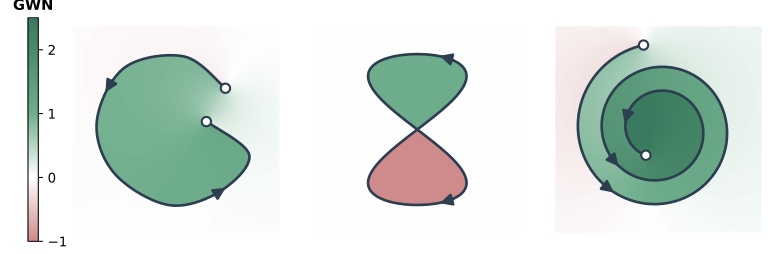
There are other existing methods for computing 2D GWNs; I cover this raycasting approach because it intuitively builds our One-Shot method.
In our paper (Martens, 2025), we propose a method to evaluate generalized winding numbers that only requires shooting a single ray and computing the angle between the endpoints.
While the naive approach would be to shoot a multitude of rays and average them all, the key observation is that: the number of signed intersections only changes at the endpoints.

In other words, the endpoints divide the plane into two regions where all rays shot within the same region share the same number of signed intersections (χ).
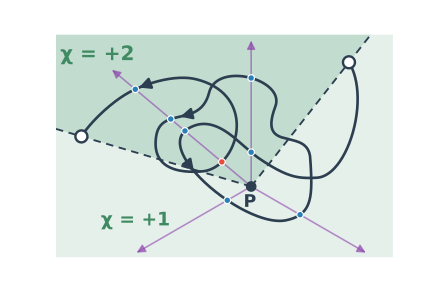
Moreover, each region’s χ differs by exactly one. Then, only a single ray is needed to compute the χ of both regions. As we rotate a ray counter-clockwise and encounter the start of the oriented curve, χ increases by 1, and it decreases by 1 when we encounter the endpoint. Then, with a single ray we can compute both χ values required to compute the Generalized Winding Number!
The One-Shot Method
Putting this all together, we conceptually want to compute the average number of signed intersections, naively obtained by shooting nearly an infinite amount of rays. With the One-Shot method, only a single ray is required to compute the sum of signed intersections (χ) constant in each of the two regions. To evaluate the GWN at a query point, we weight-sum the χ values of each region by the fraction of the circle that the region occupies, computed as the angle between endpoints in radians.
\[w(p) = \frac{\theta_1}{2\pi}\,\chi_1 + \frac{\theta_2}{2\pi}\,\chi_2\]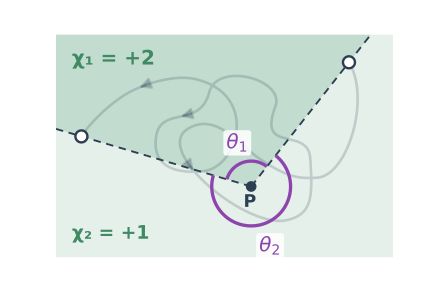
Interactive Generalized Winding Number
What’s Next
That concludes the brief introduction to the One-Shot Method in 2D. If you are interested in knowing more about winding numbers, here are a few links: